by Fmeaddons
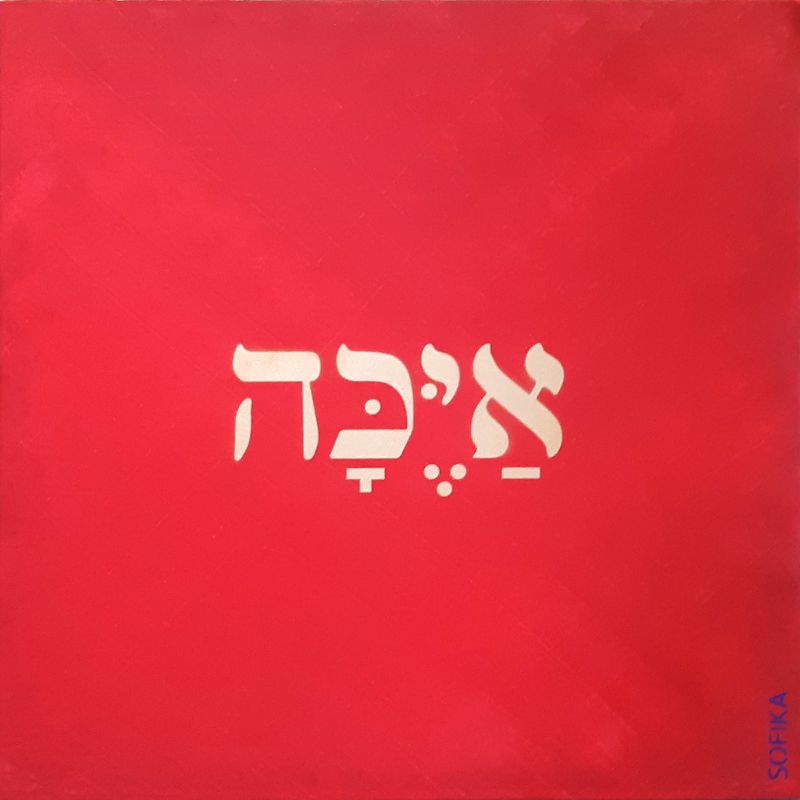
Sophia KaminskiAyeka, 2024
Sophia Kaminski, Ayeka
About the Artwork
Ayeka ("Where are you?") is inspired by the first question G-d asks humanity in the Torah. Following Adam's transgression in the Garden of Eden, G-d calls out, "Ayeka?" (Genesis 3:9). Rather than asking for Adam's physical location, Jewish tradition understands this as a timeless spiritual question directed to every human being: Where are you? Where do you stand in relation to your Creator, your purpose, and your potential? Sophia Kaminski distills this profound moment into a strikingly simple composition, allowing a single Hebrew word to become an invitation for every viewer to reflect upon their own spiritual journey.
Continue reading
The composition is intentionally minimalist. Suspended against a vibrant field of red, the Hebrew word Ayeka becomes the sole focus of the painting. Without narrative, figures, or decorative elements, Kaminski demonstrates the extraordinary expressive power of the Hebrew language itself. Here, the letters are not merely read—they become an invitation to contemplation.
In Jewish thought, Ayeka is one of the Torah's eternal questions. It is addressed not only to Adam, but to every generation. It asks us where we stand in relation to G-d, our purpose, and our responsibilities. It is a question of awareness rather than geography, inviting honest reflection, spiritual growth, and the possibility of return.
For many contemporary viewers, Ayeka also resonates in another way. In an age marked by uncertainty and suffering, Jewish tradition speaks of hester panim—the concealment of G-d's Presence. During such times, the question takes on a renewed significance. We find ourselves searching not only for our own place before G-d, but also yearning to discover His Presence within a world that can sometimes feel hidden from Him. In this sense, Ayeka becomes a profound dialogue: G-d asks humanity, "Where are you?" while humanity, in turn, searches for G-d even when His Presence appears concealed.
The vibrant red background transforms the emotional atmosphere of the painting. Red speaks of the human heart—of passion, longing, vulnerability, and spiritual urgency. Against this field of living color, the golden Hebrew letters seem to radiate with quiet certainty, reminding us that even amid life's intensity and emotional struggles, the Divine call remains constant. Rather than expressing judgment, the painting becomes an invitation to awaken the heart and begin the journey toward renewed closeness with G-d.
This work reflects one of the defining characteristics of Kaminski's artistic vision: the transformation of Hebrew words into visual experiences. Language becomes image, and image becomes meditation. Through remarkable simplicity, she reveals how a single word from the Torah can contain layers of spiritual meaning that continue to speak across generations.
Ayeka ultimately reminds us that the most important questions are often the simplest. Before change can begin, one must first pause and ask: Where am I? And perhaps, in our own generation, we also ask: Where are You? Kaminski's painting holds these two questions together, inviting an encounter between the human soul and the Divine Presence that forever calls it home.
₪ 11,200
In stock